Montessori in Action at Wayland: Holding Big Numbers in Their Hands
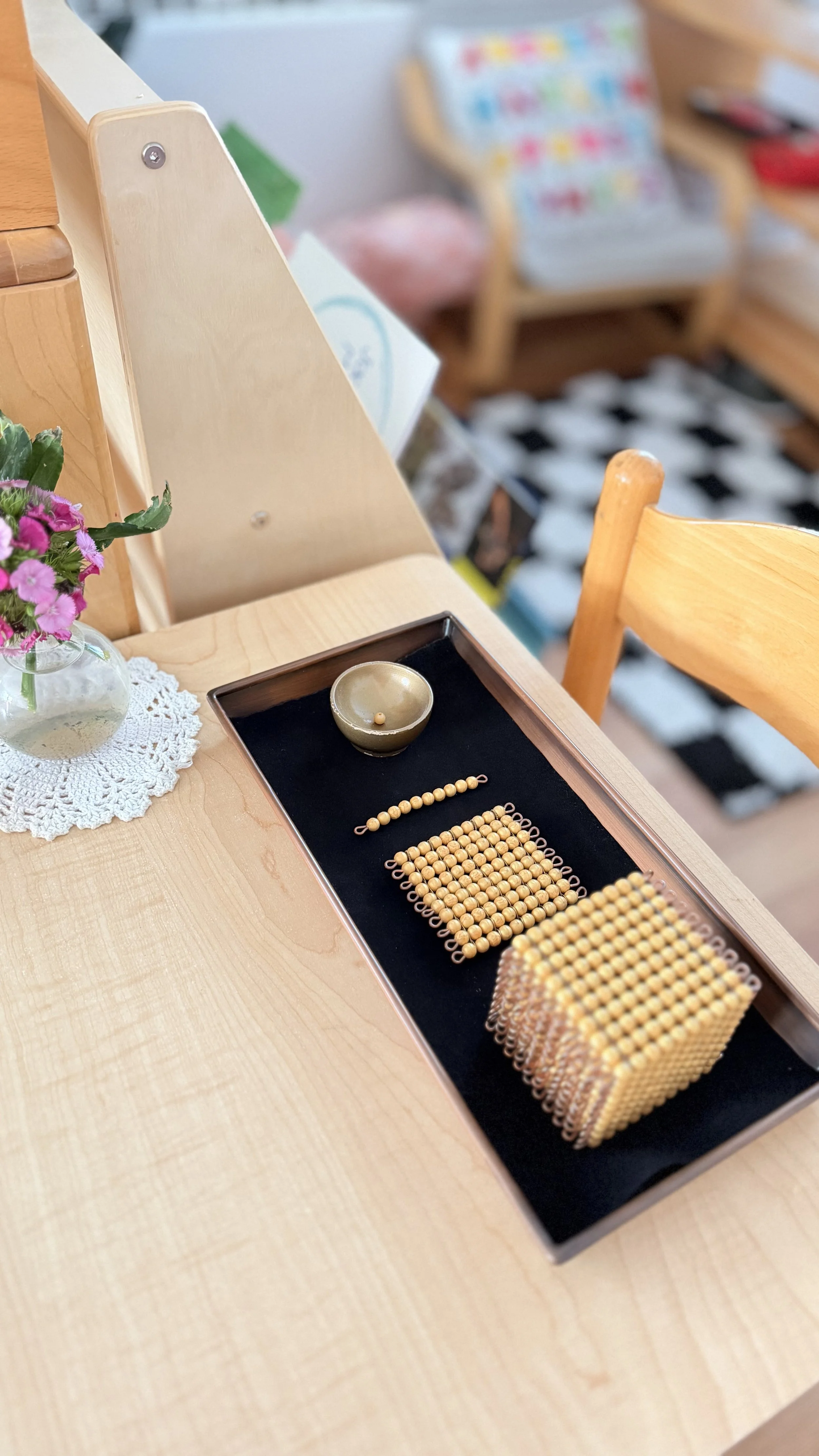
At Wayland Montessori, you may see one child counting familiar objects while another works with quantities in the thousands. Each child is offered the next lesson when they're ready, based on careful observation by their guide.
The Golden Beads are an important step in that progression.
Before a child begins this work, they've developed a strong understanding of one-to-one correspondence. They can count a group of objects and understand what the total means. When we see that foundation is in place, we introduce the decimal system with materials the child can see, touch, and carry.
The first presentation is simple. On a velvet-lined tray, the child sees one golden bead, a bar of ten beads, a square of one hundred, and a cube of one thousand. The guide names each quantity: "This is one. This is ten. This is one hundred. This is one thousand."
Then the child has time to take it in.
There's no pressure to memorize everything right away. The child may hold the materials, compare their sizes, repeat the language, and return to the work on another day. Later, when the child is ready, the guide introduces number cards so they can match the written numerals with the quantities.
This is what we mean when we say Montessori math is concrete. One thousand isn't only a number someone has explained. It's a cube the child can hold in both hands and compare with a single bead. Even four-digit numbers begin to feel understandable because the child has experienced what they represent.
The Golden Beads also give our guides valuable information. By observing how a child works with the quantities and symbols, we can see what they understand and decide when they're ready for follow-up lessons. Over time, this foundation supports work with addition, subtraction, multiplication, division, and the Bead Cabinet.
At Wayland Montessori, children don't all move through math lessons on the same schedule. One child may need more time with quantities to ten, while another is ready to explore the thousands. Our role is to notice, offer the right presentation, and give each child the time and space to practice independently.
Children often feel especially proud when they begin working with the Golden Beads. The lesson is quiet and low-pressure, but to them, it feels like a big step: "I'm ready for big-kid math."
That's a familiar kind of moment at Wayland Montessori-a beautiful material, a carefully timed lesson, and a child discovering just how much they're capable of.