Montessori vs. Traditional Preschool: What Children Learn When Art Has No One Right Answer
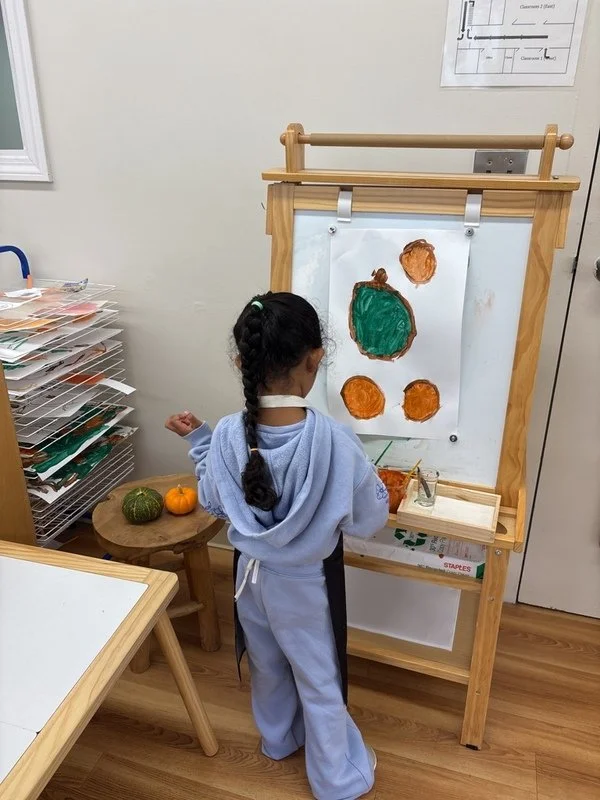
Preschool art is sometimes planned around a finished product: paint inside these lines, place each piece here, and make your picture look like the example.
In a Montessori classroom, art looks a little different.
We begin by giving children beautiful, real materials and showing them how to use each one with care. A lesson might introduce watercolor, a canvas, and the work of an artist such as Wassily Kandinsky. We’ll talk about the artist’s ideas, look closely at the shapes and colors, and demonstrate how the medium works.
Then the child creates.
A child may be inspired to paint colorful circles and squares. Another may take the work in an entirely different direction. Both are welcome. The artist and materials offer a starting point, but there isn’t one adult-defined result that every child is expected to reproduce.
Learning through cause and effect
This freedom gives children room to make choices and discover natural consequences.
What happens when two colors meet? What changes when the brush holds more water? What happens when every color is mixed in the same space?
The child sees the answer directly in the painting. If the colors become brown or muddy, we don’t correct the work or tell the child it was done “wrong.” It’s the child’s artwork and experiment. They’re learning about color, water, movement, pressure, and cause and effect through their own experience.
That’s what we mean by a natural consequence: the result comes from the child’s interaction with the material, not from an adult’s judgment or punishment.
The guide’s role
Our guides prepare the environment, introduce the materials, and show children how to use them respectfully. Then we observe.
We might offer language, answer a question, or give another presentation when a child is ready. But we also know when to pause. Children need enough time and space to notice what happened, think about it, and decide what they’d like to try next.
This is where so much learning takes place.
The child is developing fine-motor control while holding the brush. They’re refining visual discrimination as they notice differences in color and shape. They’re practicing concentration, making decisions, and building confidence in their own ideas.
The process matters
An art lesson at Wayland Montessori isn’t about making every child’s work look the same. It’s about helping children understand their tools, engage their senses, and express an idea with intention.
The finished paintings may all look different, and that’s part of the beauty of the experience. Each one reflects a child who observed, chose, experimented, and created.
At Wayland Montessori, this approach extends beyond art. Whether a child is pouring water, arranging flowers, working with math materials, or painting on a canvas, they’re given meaningful freedom within clear, respectful limits. They learn through real experience, including the natural results of their own choices.
That’s how independence grows: not by expecting perfection, but by giving children the tools, time, and trust to learn for themselves.